FIGURE 11.24 Some of the different species of finches that are found on the Galapagos Islands. The finches shown here are descendants of a common ancestor. These species differ from each other in terms of appearance, habitat, and feeding behavior. Image Source: Wikimedia Commons. These images are licensed under the Creative Commons Attribution-Share Alike 2.0 Generic license or the Creative Commons Attribution-Share Alike 3.0 Unported license. Links top left to bottom right - Geospiza conirostris (photo by Erik Beans), Geospiza fuliginosa (photo by Mark Putney), Geospiza scandens (photo by Mark Putney), Geospiza fortis (photo by Mark Putney), Certhidea olivacea (photo by Mark Putney), and Geospiza magnirostris (drawing by Charles Darwin).

Darwin’s Theory
In 1859, Charles Darwin publishedThe Origin of Species, which presented a theory to explain the origin of life's diversity. The radical idea presented in this book was partially inspired by observations Darwin made on his round-the-world trip aboard the ship HMS Beagle from 1831 to 1836. Throughout his journey, he noticed the unique geographic distribution of the species he encountered. On the isolated and geologically young Galapagos Islands, off the Pacific coast of South America, Darwin noticed the marvel of species evolution on a fine scale. Thirteen species of closely related finches lived on the island; each adapted to a specific diet of food (Figure 11.24). Some birds had heavy beaks for cracking seeds, smaller beaked birds mainly fed on fruit and flowers, and other birds with fine, narrow beaks consumed insects. On the mainland of South America, Darwin noticed completely unrelated species of birds feeding on the same foods. Darwin reasoned from this observation that possibly a single species of finch might have migrated from the mainland to the Galapagos Islands in the distant past. Soon after this single species of finch colonized, speciation occurred, causing it to diverge into 13 species over many years. A similar finch diversification did not occur on the mainland because other bird species occupied the various feeding niches.
Natural Selection, Mutations, and Reproductive Isolation
It has been suggested that nothing in modern biology would make much sense without the theory of evolution. Evolution is the process by which species come to possess genetic adaptations to their surrounding environment. An essential mechanism of evolution is natural selection. Natural selection determines the individuals in a population with the best adaptations to guarantee reproductive success (Figure 11.25). When these favored individuals reproduce, they pass on their successful adaptations to the next generation. Because environmental conditions constantly change, natural selection is always influencing the genetic characteristics of species populations.
Evolution results in temporal changes in a species' gene pool.The gene poolrefers to the total collection of genes (adaptations) in a population at any given moment. New genes enter a species’ gene pool through mutations. The pattern of genetic variation in the gene pool also changes from one generation to the next as natural selection determines which individuals are fittest. By selecting those organisms that will become reproductively successful, natural selection controls the future frequency of a population's genes and the appearance of new mutations. Temporal changes in gene frequency result in evolution.
Evolution also requires reproductive isolation to occur for extended periods. Reproductive isolation occurs when a group of organisms that interbreed is divided into two or more subpopulations. This process of isolation is often caused by the presence of a geographic barrier (Figure 11.26). This barrier can be a mountain range, a stream, or any other factor that stops species from interbreeding. Natural selection will act differently in each population if a remote subpopulation cannot trade genes with the main population due to isolation. In other words, the population will evolve along two different paths. Over time, differences in gene frequency emerge between the two populations because no two patches of habitat are entirely identical and because new adaptations enter the gene pool through mutations at the individual level. This process is known as divergent evolution.
One of the best-known examples of natural selection operating in a modern species is the development of pesticide resistance in crop pest insect species. Before the extensive use of pesticides that began in the 1940s, crop pest insect species only contained a small amount of genetic variability for resistance to these chemicals. Natural selection in the absence of pesticides cannot lead to changes in the frequencies of genes conferring resistance to chemical pesticides. However, once pesticide spraying began, individuals with resistant genes became much more common as they survived the applications. Further, they could pass a larger share of their genes into the next generation's gene pool. As a result, introducing pesticides into the environment exerted tremendous selective pressure, increasing the frequency of resistant genes in pest populations.
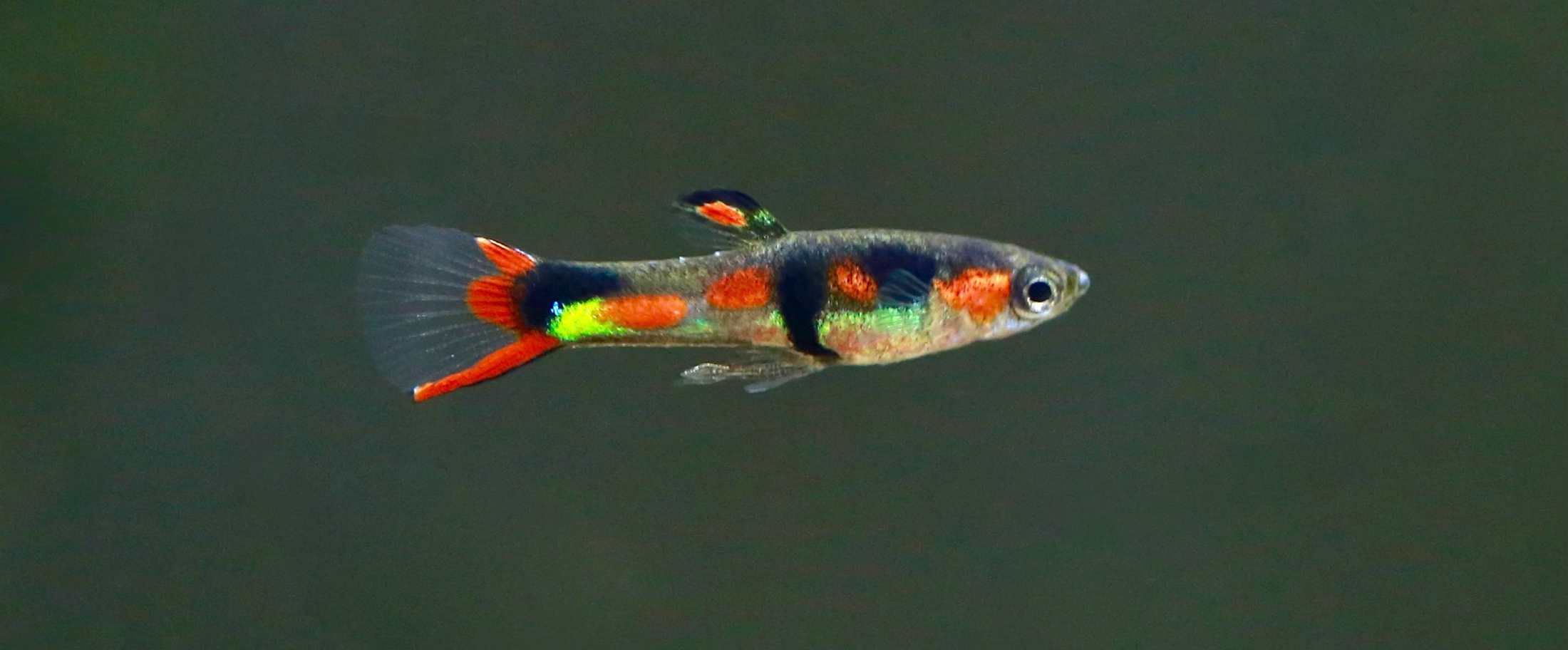
FIGURE 11.25 In the 1970s, evolutionary biologist John Endler began studying wild guppies (Poecilia wingei) on the island of Trinidad. During his studies, he observed color variation among male guppies from different streams and even within fish living in the same stream. After making many scientific measurements, Endler observed a strong correlation between where guppies lived and whether they had bright or drab coloration. Furthermore, he noticed that drab guppies lived in stream habitats alongside predators. Brightly colored guppies were found in predator-free habitats. John Endler hypothesized that natural selection was acting on guppies to produce color variations. Drab fish were selected when the streams contained predators. Predators were consuming the more easily seen, colorful individual. In streams where the predators were absent, brightly colored guppies had higher reproductive success rates because female guppies preferred to mate with these fish over the drab males. Image Copyright: Michael Pidwirny.

FIGURE 11.26 On the West Coast of North America lives a species of salamander known as Ensatina escholtzii. This species has several subspecies, each with unique skin coloration and spatial distribution. Biologists believe that all of these subspecies originated from a single ancestor that lived long ago in Oregon. Over time, relatives of this ancestor dispersed to the north into Washington and British Columbia, Canada, and to the south into California and Mexico. As the salamanders moved south, the species became split by the San Joaquin Valley in central California. This geographical barrier led to reproductive isolation, and the populations on either side of the San Joaquin Valley became increasingly dissimilar as you traveled further south. In some areas of southern California, the two populations come into contact but cannot interbreed. They are now essentially separate species because of reproductive isolation and natural selection. Image Copyright: Michael Pidwirny.