Figure 6.30 describes the annual values of net shortwave and net longwave radiation from the South Pole to the North Pole. On closer examination of this graph, one notes that the lines representing incoming and outgoing radiation do not have the same values. From 0 to about 35° latitude North and South, incoming solar radiation exceeds outgoing terrestrial radiation, and a surplus of energy exists. The reverse holds true between 35 ° and 90° latitude North and South, and these regions have an energy deficit. Surplus energy at low latitudes and a deficit at high latitudes result in a net energy transfer from the equator to the poles. This meridional heat transport generates atmospheric and oceanic circulation. If there were no energy transfer, the North and South Poles would be 25°C (45°F) cooler, and the equator 14°C (25°F) warmer!
The redistribution of energy across the Earth's surface is primarily accomplished through sensible heat flux, latent heat flux, and ocean surface heat flux. Sensible heat flux is the process by which heat energy is transferred from the Earth's surface to the atmosphere by conduction and convection. This energy is then moved from the tropics to the poles by advection, creating atmospheric circulation. As a result, atmospheric circulation moves warm tropical air to the polar regions and cold air from the poles to the equator. Latent heat flux moves energy globally when solid and liquid water is converted into vapor. This vapor is often carried by our planet's atmospheric circulation vertically and horizontally to cooler regions, where it condenses as rain or snow, releasing the heat energy it stored. Finally, large quantities of radiation energy are transferred into the Earth's tropical oceans by surface heat flux. Energy enters these water bodies at the surface when absorbed radiation is converted into heat energy. The warmed surface water is then transferred downward into the water column by conduction and convection. Ocean currents then move this heat energy horizontally from low latitudes to high latitudes.
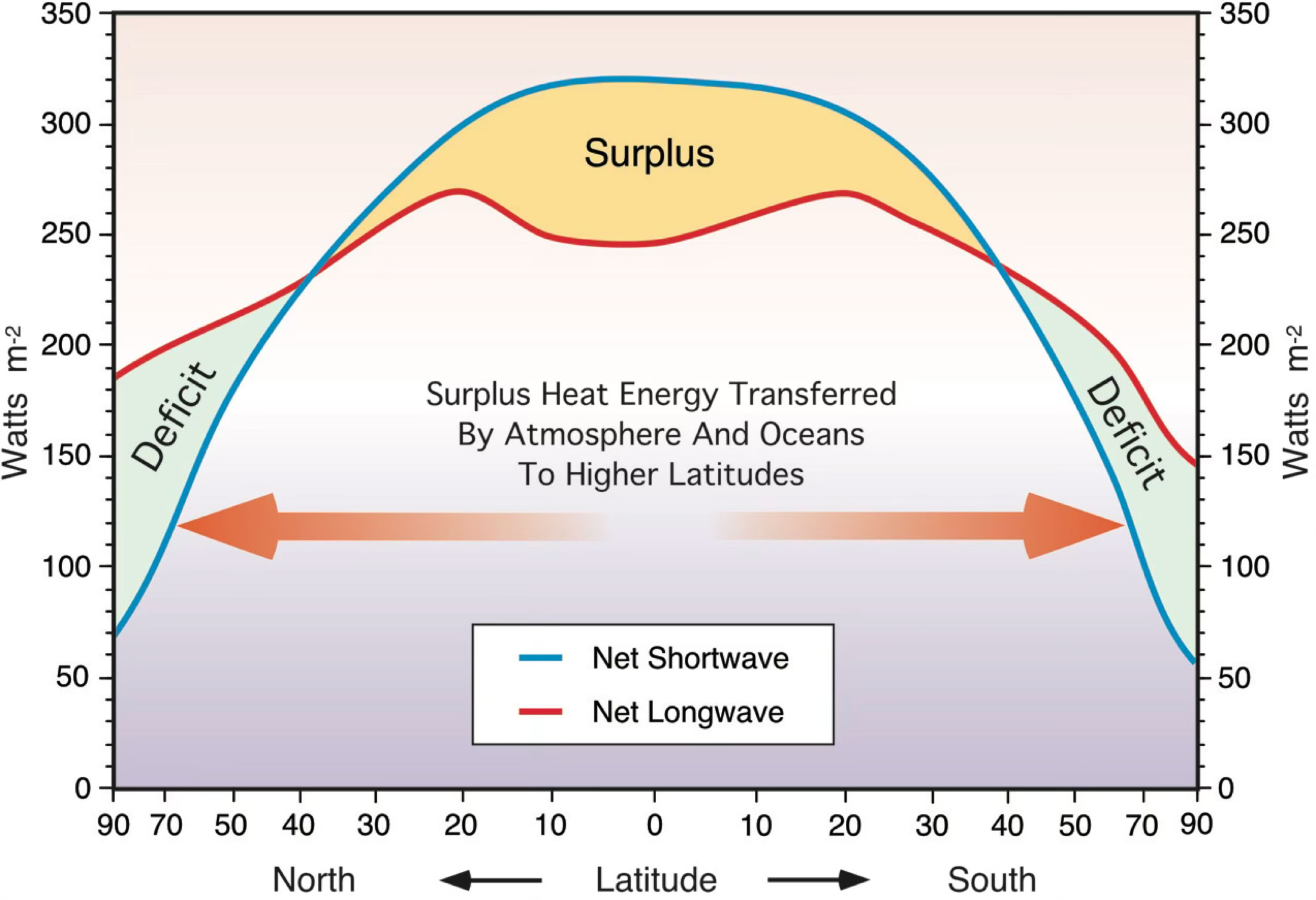
FIGURE 6.30 The global balance between net shortwave and net longwave radiation from the equator to 90° North and South. Tropical and subtropical regions have a surplus of heat energy, while middle and high latitude regions have a deficit. Image Copyright: Michael Pidwirny.